What Counts as a Camping Cabin? Cabins vs. Yurts, oTENTiks and Other Rustic Options
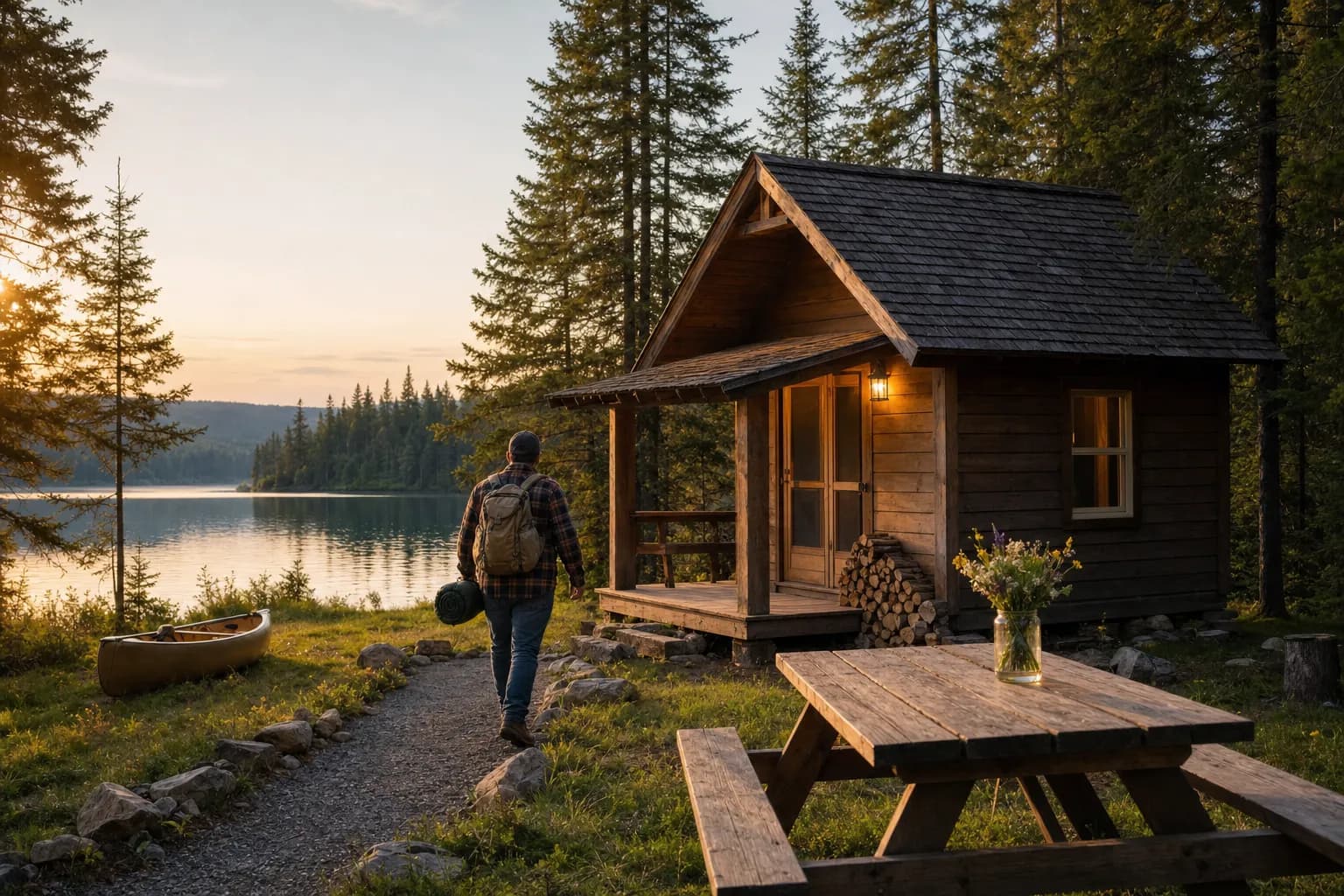
A camping cabin is a small, basic structure — usually one or two rooms with bunks or a sleeping platform, a table, and sometimes electrical outlets or a wood stove — that gives you four solid walls and a roof without the cost or commitment of a full rental cottage. Think of a camp cabin as the halfway point between a tent and a full-service cabin rental: you're still bringing your own bedding, cooking gear, and usually hauling water, but you're sleeping off the ground and out of the wind. In provincial and national parks across Ontario, Alberta and BC, this category has expanded well beyond the classic log cabin, and the terminology can get confusing fast.
Here's how the main options break down:
| Structure | What it is | Typical comfort level |
|---|---|---|
| Rustic cabin | Wood-frame, bunks or platform, no plumbing | Basic — bring everything |
| Yurt | Canvas or vinyl walls on a round frame, often insulated | Mid-range — some have heat |
| oTENTik | Parks Canada's signature hybrid — canvas walls, wood floor and frame, raised beds | Mid-range, consistent across parks |
| microCube | Compact, modern sleeping pod, minimal footprint | Basic, weather-tight |
| RVezy-style cabin rental | Privately listed cabin on a campground or private land | Varies widely — some fully furnished |
Rustic cabins are the no-frills option you'll still find in older sections of many Ontario Parks campgrounds — a roof and a door, nothing more. Yurts show up more in BC and parts of Alberta Parks, often with a woodstove or electric heater, which makes them a solid shoulder-season pick when overnight temperatures can dip below 0°C. oTENTiks are a Parks Canada trademark — you'll find them in national parks from coast to coast, and they're reliably consistent in layout, which is handy if you're booking somewhere you've never visited. microCubes are the newest addition, compact and efficient, aimed at travellers who want shelter without the footprint of a full cabin. Then there's the RVezy-style cabin rental: privately owned, listed independently, and sitting outside the standard park reservation system entirely.
Knowing which category you're booking matters — it changes what you pack, what you pay, and what you can expect when you pull in. For a deeper comparison with real examples, check out our guide to the Best Cabin Camping Near You in Canada.
Typical Amenities: What's Inside (and Outside) a Camp Cabin
Walk into a typical camp cabin and you'll usually find the basics covered, but not much more. That's the whole point — a camping cabin bridges the gap between a tent and a cottage, so don't expect hotel-level fit-out. Here's what's standard across most provincial and national park cabins, with the caveat that every property is a little different.
Sleeping setup. Most cabins sleep four to six people on built-in bunks — usually one double and a couple of singles, or stacked twin bunks. In almost every case, you're bringing your own sleeping bag, pillow and pad. Some cabins have bare wooden platforms; others include thin foam mattresses. Don't assume bedding is supplied unless the park explicitly says so on the official listing.
Power and heat. Electrical cabins typically have a couple of outlets and overhead lighting, enough to charge phones and run a small fan or space heater. Heat sources vary: some cabins have a wood stove (BYO firewood or buy it on-site), others have electric baseboard heat, and a few rely on nothing more than insulation and your sleeping bag. If you're booking a shoulder-season or winter trip, this detail matters a lot — check it before you go, since a wood-stove-only cabin in February is a different experience than one with electric heat.
Fridges and cooking. A small bar fridge shows up in some of the nicer non-backcountry cabins, but plenty have none at all — pack a cooler as backup. Cooking is almost always outside: you'll have a camp stove or the fire pit, not an indoor kitchen.
Porches and outdoor space. Screened-in porches are common and honestly one of the best features — great for keeping bugs out while you eat breakfast or play cards. Outside, expect a picnic table, a fire pit or metal fire ring, and sometimes a gravel pad for parking right at the site.
Quick checklist before you book:
- Electrical or non-electrical site?
- Mattress included, or platform only?
- Heat source — wood stove, electric, or none?
- Fridge on-site or bring a cooler?
- Screened porch or open deck?
Always confirm these details on the park's official booking page, since amenities can change between seasons or even between individual cabins in the same loop.
Provincial and National Park Cabin Programs Across Canada
Every major park system in Canada runs its own version of a camp cabin program, and the differences matter when you're deciding where to book. Availability, pricing, and even the terminology shift from one province to the next, so it pays to know what you're actually reserving before you get your heart set on a particular park.
Ontario Parks has one of the most developed cabin networks in the country. You'll find roofed accommodations ranging from basic camp cabins with bunks and a table to more fully equipped yurts with heat and electricity, scattered across parks like Pinery, Killbear, and Algonquin. Some cabins sit on their own loop away from the main campground, which is worth asking about if you want distance from tent and RV sites. Book through the Ontario Parks reservation page, and expect the busiest weekends (long weekends, especially) to fill within minutes of the reservation window opening.
BC Parks offers fewer standalone cabins than Ontario but has been expanding rustic shelter and yurt options at parks near Vancouver Island and the Okanagan. Pricing and availability details change often, so check the BC Parks reservation system directly rather than relying on older trip reports.
Alberta Parks runs a comparable program, with camper cabins at popular destinations near Banff, Jasper's provincial-park adjacent sites, and in parks close to Calgary and Edmonton. Alberta's cabins tend to be simple — a roof, bunks, maybe a small heater — so pack as though you're still tent camping, just with a sturdier wall between you and the weather. See Alberta Parks for current listings.
Parks Canada, which manages the national park system, popularized the oTENTik — a hybrid of a tent and a cabin with a wood floor, frame walls, and a canvas roof. You'll find them in national parks from coast to coast, including Banff, Jasper, and several Ontario and Atlantic parks. Some national parks also offer traditional cabins or heated shelters for shoulder-season and winter camping. Check the Parks Canada reservation service for specific park listings, since not every national park offers roofed accommodation.
| System | Typical Name | Best For |
|---|---|---|
| Ontario Parks | Camp cabin, yurt | Family trips, shoulder season |
| BC Parks | Cabin, rustic shelter | Limited but growing options |
| Alberta Parks | Camper cabin | Simple, budget-friendly stays |
| Parks Canada | oTENTik, cabin | National park experiences, winter camping |
Fees, opening dates, and booking windows change year to year, so always verify details on the official park page before you plan around a specific cabin. For more help narrowing down a park and site, browse the guides at Everything Camping Canada.
Booking Windows, Pricing and What's Included
Booking a camping cabin in Canada runs on the same clock as booking a regular campsite, but the good ones sell out faster because there are fewer of them to go around. Most provincial and national park systems open their reservation windows months ahead of the season, and cabins — being warm, dry and popular with families — tend to go first.
Parks Canada typically opens reservations in January for the upcoming summer, with a rolling booking window after that. Provincial systems vary: some use a fixed release date where everyone logs in at once (expect the website to crawl that morning), while others use a rolling window of three to five months from any given date. If you want a specific camp cabin for a long weekend in July, mark your calendar for the exact release date and have your account set up and payment info saved beforehand. We've watched prime cabins vanish within minutes of a release.
A few parks still use lottery systems for their most in-demand cabins, especially ones with lake views or easy walk-in access. You apply within a set window, and successful applicants are notified afterward — no need to refresh the page at midnight.
Typical pricing (always confirm current rates on the official site, since these shift yearly):
| Province | Basic camp cabin | Larger/serviced cabin |
|---|---|---|
| BC | ~$70–100/night | $120–200+/night |
| Alberta | ~$80–110/night | $130–220+/night |
| Ontario | ~$90–130/night | $150–250+/night |
Shoulder-season rates (May, September, October) often drop below peak summer pricing, and some parks offer discounted off-season cabin stays through the colder months — a great way to try winter camping without actually sleeping on the ground.
Watch for extra fees that aren't always obvious at checkout: a mandatory cleaning fee, a per-pet charge if the cabin is pet-friendly (many aren't — don't assume), bundled or à la carte firewood, and sometimes a non-refundable booking fee. Cancellation policies differ by park too, so read the fine print before you commit.
Before finalizing any trip, double-check the park's official reservation page for current fees, cabin availability and cancellation terms, and glance at Environment and Climate Change Canada's forecast as your date approaches. For the full rundown of where to search and compare, head back to Everything Camping Canada.
Choosing the Right Cabin: Location, Capacity, Pets, Accessibility and Season
Picking the right camping cabin comes down to five questions: where do you want to be, how many people are you bringing, is anyone travelling with a pet, does anyone in your group need accessible features, and are you camping in shoulder season or deep winter? Answer those first, and the search gets a lot shorter.
Location matters more than you'd think. A lakefront cabin at a park like Algonquin Provincial Park sounds idyllic, but those units book out fastest and often cost more. Trail-adjacent cabins near a day-use area give you easy hiking or paddling access without the premium, while backcountry cabins — reached by boat, ski, or a multi-kilometre hike — trade convenience for solitude and usually mean hauling in your own water and gear. If quiet matters to you, ask (or check the site map) whether your loop backs onto a road, a boat launch, or another cabin cluster.
Capacity isn't just about bed count. A cabin listed for six people might sleep four adults comfortably and two kids in a loft — fine for a family, tight for six adults with gear. Check bunk configuration, not just the stated maximum, especially if you're bringing extra camping cots or need floor space for a pet bed.
Pets and accessibility aren't guaranteed. Never assume a cabin is pet-friendly or wheelchair-accessible — confirm directly on the park's official cabin listing before booking, since this varies by unit, not just by park.
Season changes everything. Some cabins operate summer-only and close for the off-season; others are winterized with heat sources for cross-country skiing or ice fishing trips. Before booking a winter stay, check Environment and Climate Change Canada's forecasts and any current wildfire advisories if you're travelling in shoulder season, since access roads can be affected.
Quick checklist before you book:
- Confirm pet policy in writing, not by assumption
- Ask about accessible pathways, not just accessible units
- Check if the cabin is winterized or summer-only
- Match sleeping capacity to your actual group, not the listed maximum
- Review the park's official site map for loop and proximity details
For more detail on finding the right fit, Everything Camping Canada has guides for several parks — start at everythingcamping.ca.
People Also Ask
How much does it cost to rent a camping cabin in Canada?
Pricing swings a lot depending on the park, the season and how many people the cabin sleeps — think anywhere from around $70 a night for a basic rustic cabin up to $200+ CAD for a serviced, heated option with a kitchenette. Peak summer weekends and holiday long weekends push rates higher, and some parks add cleaning or booking fees on top. Always check the specific park's official fee schedule before you plan a trip, since rates get updated yearly.
What is the difference between a camping cabin and a yurt or oTENTik?
A camping cabin is typically a small wooden structure with solid walls, a door that locks, and sometimes basic electrical service — closer to a tiny house than a tent. An oTENTik, a Parks Canada design, is a hybrid: a raised wood floor and frame with heavy canvas walls, giving you more of a glamping feel than a hard-sided cabin. Yurts fall somewhere in between, with a canvas or fabric exterior stretched over a round wooden frame. If you want real walls and a locking door, go cabin; if you're fine with canvas and want something closer to classic camping, a yurt or oTENTik works too.
How far in advance do you need to book a camp cabin in provincial or national parks?
Cabins are some of the first sites to disappear, especially for July and August weekends, so book the moment the reservation window opens — often months ahead. Parks Canada and most provincial park systems publish exact reservation opening dates on their booking pages, and popular cabins near lakes or town sites can fill within minutes. Set a calendar reminder and have your dates ready to go the second booking opens.
Do camping cabins have electricity, heat, and bathrooms?
It varies a lot, so never assume. Some cabins include electrical outlets, baseboard heaters and even a mini-fridge, while others are unserviced with no power at all and rely on a wood stove or nothing more than good sleeping bags. Washrooms are almost always a separate shared building nearby rather than an ensuite, though a few higher-end cabins buck that trend. Check the amenities list on the specific cabin's booking page — don't guess based on what another park offers.